
The survey has closed, the responses are in, and the report already shows which themes are strong and which need attention. Suppose the overall result looks healthy, but employee development scores noticeably lower. The first explanation that comes to mind is more training.
That explanation can miss the point. Some employees do not know what a promotion requires; others understand the requirements but have spent a year doing the same work. In other cases, growth opportunities exist, but nobody communicates them clearly.
One score cannot tell you which explanation is right. Before launching an initiative, find out what sits behind the result.
The overall score is only the beginning
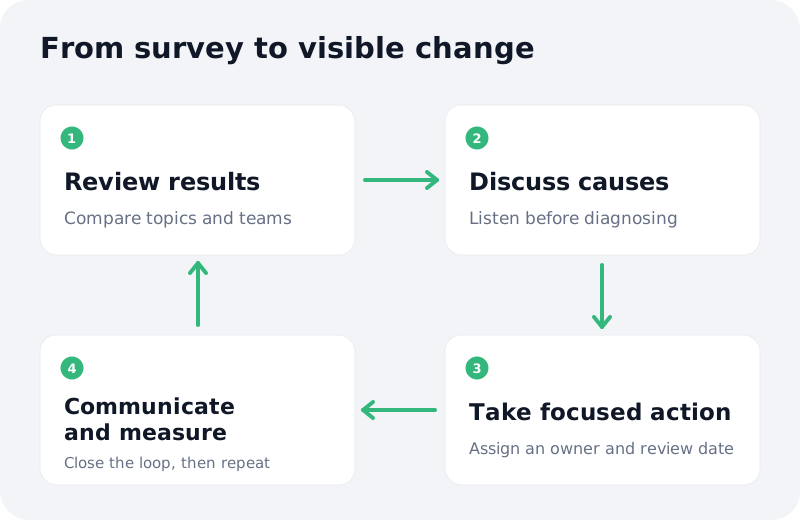
As we explained in our earlier guide to the employee engagement survey template, the Engagement Score is a headline measure designed for comparison across survey cycles. If it was 72 and is now 66, the change matters, but it does not explain much on its own. Open the results by topic and team before drawing a conclusion.
Imagine the departmental scores look like this:
| Department | Score |
|---|---|
| Product | 78 |
| Sales | 73 |
| Support | 52 |
The company average looks unremarkable, but Support clearly stands apart. That gives you a useful place to begin the conversation: has the team been understaffed, did a management change affect the work, or is one everyday process continually frustrating people?
Individual questions need the same care. A low feedback score does not necessarily mean employees meet with their managers too rarely. One-to-ones can happen every week and still be consumed entirely by tasks and deadlines; an employee can speak with a manager regularly and have no idea how that manager views their work.
The report points to an area that needs attention; comments help you investigate the cause. Not every comment requires a response, and one person describing a frustrating process does not make it a company-wide problem. When the same thought appears independently across several teams, it becomes much harder to dismiss as an isolated complaint.
Avoid over-segmenting small groups. If a filter leaves only two or three respondents, a formally anonymous survey no longer feels anonymous. A less detailed report is safer in that situation.
Discuss the results with the people who answered
Gallup gives a useful example from its work with survey results. A manager saw a low score for materials and equipment and blamed a delayed computer-system installation. When employees discussed the result, the actual concern turned out to be permanent workspaces and desks, not computers.[1]
The manager's explanation was sensible, and wrong. Survey charts invite this kind of shortcut: a weak resources score becomes an equipment problem; a low development score produces a training request. If recognition is down, attention shifts straight to praise. None of those diagnoses is confirmed by the score alone.
Discussing a result with the team is more useful than asking the People team to decode every number in isolation. It does not require a separate workshop. One question in an existing team meeting can be enough:
Our feedback score fell from 7.1 to 5.9 over six months. What changed during that time?
Then avoid suggesting the answer. If people say meetings became less frequent, the cause is clearer. If the number of meetings stayed the same but every conversation turned into a task-and-deadline review, you are dealing with a different problem.
The discussion can also move away from the original question. Employees can give goal clarity a low score even though the goals themselves are understood; priorities change several times a week, so nobody knows which task matters now. A questionnaire rarely captures that full context. In the same article cited above, Gallup recommends discussing results with the working group before deciding which themes to address.[1]
Do not turn the entire report into a project plan
Pick a small number of issues the organization can influence now. Almost every engagement survey uncovers several weak areas, but turning every theme into an initiative creates another large backlog rather than a workable response.
The lowest score does not have to come first. Suppose development scored 5.2 out of 10, and the discussion shows that the issue involves roles, levels, and the promotion system. Meaningful change will take months.
Priority clarity scored 6.1, yet the comments reveal a more immediate problem: leadership decisions reach teams too late, so people continue working on tasks that are no longer important. Leaders can document changed priorities in one consistent place and ask the same survey question again after employees have had time to experience the new process.
Choosing priority clarity does not mean development no longer matters. It means that one cause is understood, and there is a practical action whose effect can be checked.
Gallup recommends selecting two or three items rather than trying to address the entire report at once.[2] Qualtrics makes a related point: the quality of actionable insight matters more than the quantity.[3]
Turn each change into a concrete task
Survey discussions often end with phrases such as “improve communication” or “work on employee development.” Two months later, it is difficult to tell whether anything happened. Take the agreement one step further and define an observable action.
For unclear professional growth, specify which roles and levels will be documented this quarter. If employees keep losing track of priorities, decide where changes will be recorded and who will keep that record current. A feedback problem needs a clear change in conversations between managers and employees, not just a reminder to “give more feedback.”
The action does not have to be large. Removing one approval step or changing one recurring meeting can be more useful than launching a company-wide program. What every action does need is an owner and a date when the team will return to it; without both, the decision disappears into everyday work.
Gallup’s action-planning guidance also connects survey results with a concrete plan and regular progress checks.[2]
Close the loop with employees
There is a particularly damaging scenario: the company collects feedback, the People team analyzes it, and managers even change something, but employees never hear about it. For the person who completed the survey, the experience is simpler: they answered the questions, then there was silence. The next survey arrives six months later and feels different.
Gallup notes that collecting feedback without acting on it can backfire. When employees see meaningful action, they are more likely to trust the survey process.[4]
Employees do not need a large internal report. A short update can explain which theme appeared across the responses and what the company decided to do about it.
For example:
Professional growth appeared repeatedly in the responses. The clearest issue is that expectations for the next level are not equally clear across teams. This quarter we will start with the roles where the concern appeared most often, then ask employees what still needs work.
If an issue will not be addressed yet, say so directly. Not every problem can be fixed in a month; some decisions depend on budgets, reorganizations, or another substantial change. Employees should at least know that their answer did not disappear into a report.
CIPD describes a similar “You said, we did” practice: an organization returns to employees and shows the connection between the feedback it received and the actions that followed.[5]
Measure the topic you actually changed
Measure the topic you changed, not the entire survey. If the company spent several months improving manager feedback, run a short pulse survey with the relevant questions. If it changed its approach to development, check development.
The score does not always rise. When the chosen action has no effect, speak with the team again and revisit the original explanation. This is a normal part of working with survey data: a survey does not provide a ready-made solution, but it helps you notice a problem and test what changes after a specific action.
Qualtrics connects action planning to the same continuing process: choose an area for improvement, define actions, and track them after the survey.[6]
The overall Engagement Score can remain almost unchanged when the company has addressed one narrow factor. In that case, the useful measure is the question connected to the process that changed. After several cycles, a history begins to emerge: what employees noticed, what the company changed, and which themes moved afterwards. Without that work, the report quickly becomes little more than a collection of charts.
Employee engagement surveys in formeasure
With formeasure, you can run an employee engagement survey, compare topics and teams, and track the same measures in later survey cycles.
A ready-to-use template is already available in the platform.
Use the employee engagement survey template →
If you are still preparing the survey, start with our employee engagement survey questions and ready-to-use template.
We have also previously explained how to calculate employee eNPS and what to do with the result.
Frequently asked questions
What should you do immediately after an employee engagement survey?
Compare the overall result with the previous survey, review differences between groups that are large enough to protect anonymity, and read the open comments. Discuss likely causes with employees before launching changes.
How many actions should you choose after an engagement survey?
Choose two or three focused issues the team can realistically influence. Give every action an owner, a deadline, and a clear way to check whether it happened.
Should you share engagement survey results with employees?
Yes. Explain the themes you heard, what the company will change, and what it is not ready to address yet. Closing the loop shows employees that their feedback did not disappear when the survey closed.
When should you repeat an employee engagement survey?
You do not have to repeat the full survey immediately. Use a short pulse survey to check the topic you changed, then keep the full engagement survey on its normal cycle.
Sources
- Gallup, What to Do With Employee Survey Results.
- Gallup, Implementing Workplace Survey Best Practices.
- Qualtrics, Reporting on Your Employee Engagement Project Results.
- Gallup, Employee Surveys: Types, Tools and Best Practices.
- CIPD, Maximising Employee Voice in a Hybrid Working World.
- Qualtrics, Guided Action Planning.